The 15-Point Automation Audit I Run Before Any Client Engagement
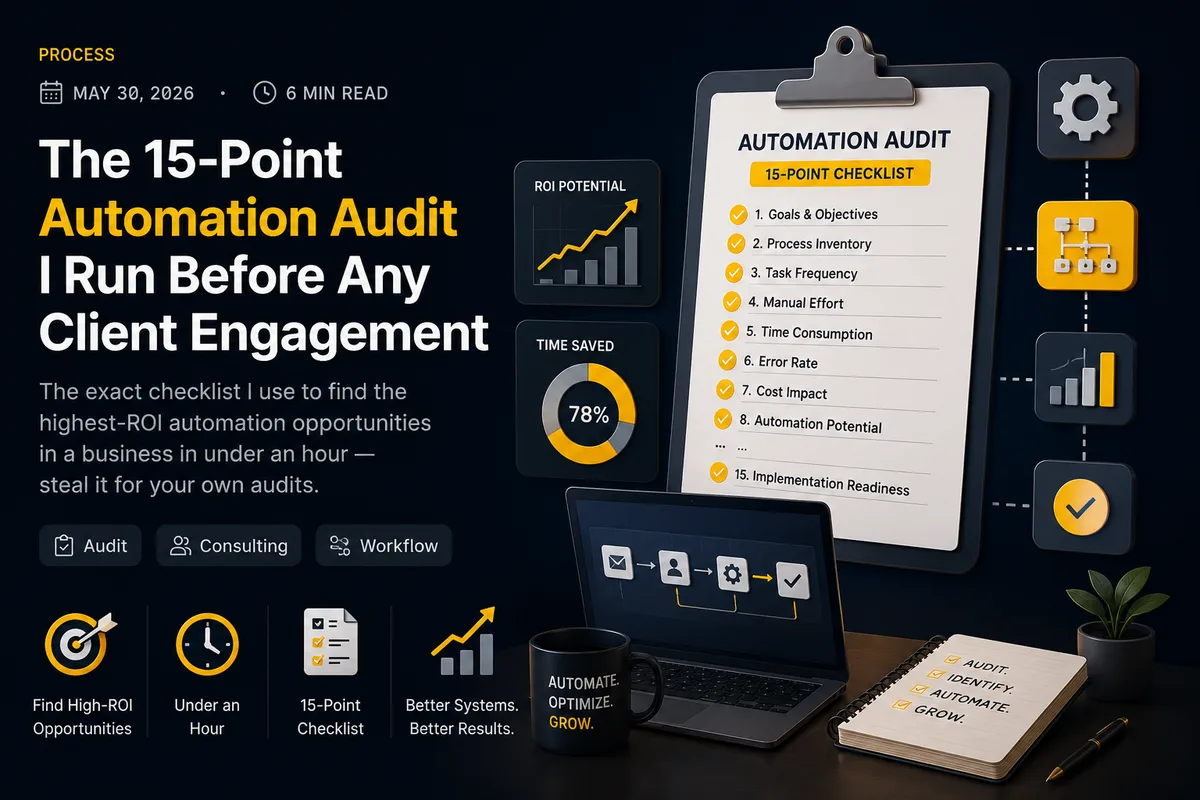
Before I write a single line of a workflow, I run an audit. Not because it's billable — because automating the wrong thing is worse than automating nothing. The goal of this checklist is brutally simple: find the tasks that are frequent, manual, and rule-based, because that's where automation prints time and money. Here's the exact 15-point pass I run, usually in under an hour.
The whole audit hunts for one shape of task: something that happens often, follows predictable rules, and currently eats a human's attention. Hit all three and you've found ROI.
Part 1 — Map where the time actually goes
- 1.List the daily repeaters. What does the team do every single day, by hand? Copy-pasting, data entry, sending the same reply — these are the obvious wins.
- 2.Find the copy-paste bridges. Anywhere a human moves data from one app to another (form → spreadsheet → CRM) is a workflow waiting to be built.
- 3.Spot the 'we always forget' tasks. Follow-ups, reminders, status updates — things that depend on someone remembering are perfect for automation.
- 4.Count the frequency. A 5-minute task done 40 times a week beats a 2-hour task done once a month. Volume is where the hours hide.
- 5.Tag the rule-based vs. judgment calls. If you can describe it as 'if this, then that,' it's automatable today. If it needs real human judgment, it's not (yet).
Part 2 — Check the data and the tools
- 1.Is the data structured? Clean fields in a form or sheet automate easily; messy free-text needs an AI step first.
- 2.Do the tools have APIs or native connectors? Mainstream tools (Google, Slack, HubSpot, Stripe) are easy. A legacy system with no API changes the plan.
- 3.Where does the single source of truth live? If the same data exists in three places, fix that first — automating on top of chaos just spreads the chaos faster.
- 4.What triggers the work? A new email, a form submission, a schedule, a webhook? Every automation needs a clear starting gun.
- 5.What's the volume ceiling? Knowing peak load decides the platform and the pricing model before anything gets built.
Part 3 — Pressure-test the ROI and the risk
- 1.Calculate the hours saved. Frequency × time-per-task × people doing it. Put a real number on it — that's the business case.
- 2.Estimate the error cost. What does a manual mistake cost today (a missed lead, a wrong invoice)? Automation's reliability is often worth more than the time it saves.
- 3.Define what 'broken' looks like. Every workflow needs error handling and an alert. If it fails silently, it'll fail expensively.
- 4.Check the human handoff. Where should a person still approve or step in? The best automations augment the team — they don't fully replace judgment.
- 5.Score it: build now, later, or never. High frequency + clear rules + clean data = build now. Anything failing two of those gets parked.
How to use the score
Run every candidate task through points 11–15 and you'll naturally get a ranked list. I build the top one or two first — the ones with the highest hours-saved and the cleanest rules — ship them, prove the value, then move down the list. Trying to automate everything at once is the fastest way to a fragile system nobody trusts.
You don't need 20 automations. You need the three that quietly give you back ten hours a week — and the discipline to build those first.
The one mistake to avoid
Don't automate a broken process. If a workflow is messy, unclear, or changes every week, automation will faithfully reproduce the mess at machine speed. Fix or simplify the process on paper first — then automate the clean version. A good audit catches this before you've wasted a build on it.
Want me to run this audit on your business? Book a free 30-minute call and I'll walk your workflows through all 15 points live — you'll leave with a ranked list of your highest-ROI automations, whether or not we work together.
Want this kind of automation in your business?
Book a free 30-minute audit and I'll map the highest-ROI workflows for your specific setup — no pitch, no commitment.